Who or What is Elo de Norjeles?       Poetry       Prose      

Musings       Photography       Reviews

Wednesday, September 17, 2014

Where have all the ribbons gone?


Thirteen years is long enough for memory to stale.

But it can’t erase video footage. 

For twelve years, I have remembered 9/11 by reliving it. I planted dozens of flags with the College Republicans on campus until my thumbs blistered, I viewed dramatizations with my family, I held the steel beam of the World Trade Center inside the 9/11 memorial pointing to NORAD at UCCS, I wrote poetry to encapsulate that skipped heartbeat at the first reports.

Everyone grieves differently. National grieving and memorials are complicated. But where is the dividing line between remembrance of lives lost and repeated infliction of a past horror? When do we let go of pain?

“Never Forget: 9/11/2001” is a well-meant slogan, but is also quite nebulous. How are we to never forget? And what are healthy ways to grieve and remember?

Technology now enables humans to re-experience a traumatic event in precisely the same way that they first lived it. Most Americans experienced 9/11 via televised broadcasts on a major news network. So replaying the footage each year allows us to relive the trauma – literally. 

This year, I avoided the newscasts, remembering in my heart alone. But at dinner in the campus pub with my best friend, one glance at the television screen regurgitated all my preteen shock at the first plane hitting the tower. I wasn’t sure if I was about to sob or vomit. 

Where have all the flowers gone? I think they took our old quieter traditions of remembrance with them. Yellow ribbons, photographs, gold stars on WW2 deployment flags, toy cars left at children’s tombstones. Empathy for others' pain is essential, and while modern society may seem calloused, less obvious ways of commemorating loss should not be discounted. True memorials are built in the heart. As J.K Rowling is so often quoted, “the ones that love us never really leave us.”

If I die in a terrorist attack, or natural disaster, or even in a car accident tomorrow, I don’t want to be remembered for how I died. I want my life to be remembered – the beautiful and crazy quarter century I had. If my last moments are painful, I don’t want my loved ones to obsess over them. I want them to “remember when we'd / stay up late and we'd talk all night / in a dark room lit by the TV light” (Skillet). All those little breaths strung together that constitute being alive.

We do the 2,977 people who died on 9/11 a disservice when we generalize them as “the fallen” or “the victims.” Each one had lives and families diverse enough to make a synesthete’s head swim in color and sound.  

Perhaps Christians often view remembering Jesus with communion almost the same way. We think about the torture in the last 12 hours of a 33 year life, as Cynthia Jeub recently wrote. I only realized this similarity recently when listening to a song in an Easter play from my childhood. During the last supper scene, Jesus sings:

“The time is near that I must leave you.
It hurts me so that we must part.
But just as we have remembered,
Remember our moments together.

In all you do,
In all you say,
Remember me,
Remember me.

Remember how amazed you were
the day I turned the water into wine?
You had not known me very long,
yet you believed I was sent from God.
Those were such good times,
Those were such good times.
Remember, remember.

(Disciples)
Remember how we laughed so long
the day that 10 lepers were healed?
They were so happy to behold.
But only one had returned to thank you
Those were such good times,
Those were such good times.
Remember, remember.”

Although wine and bread representing body and blood are mentioned in some of the closing verses, the song emphasizes the life, not the death. If I actually love Jesus, wouldn't I want all of his life? Not just the end? And if I want to honor the 2,997, wouldn’t I listen to how their family members and friends remember them?

Next year, I think I’ll read some biographical sketches of people who died on 9/11, google some photographs. And skip the video replays.

Tuesday, June 17, 2014

The Lighthouse Girl


There was once was a little girl, raised in the Village.

The Village was a utopia, walled off for protection and insulated from the world. Even the families in the girl’s section of the Village did not see each other very often, but lived peaceably, like hermits, in accordance with the Code.

When the girl grew to be a maiden, sometimes she crept through cracks in the wall and explored the countryside. 


She gradually even made friends with the woodland folk, discovering new ballads and gypsy dances banned in the Village.

One day, the elders of the Village told the girl that absolute obedience was the only way to honor her parents and the Code. But the girl had dreams, and this meant soul death.

So one night the girl left the Village forever.

Her friends on the outside helped her travel to the coast, where she built a lighthouse with bricks and mortar and timber they brought. That section of the coast was so rugged that the deaths on its rocks were legend. Other attempts to build lighthouses had not survived.

The girl maintained it for years, weathering many storms. Her friends visited often to encourage her and the prosperity of the lighthouse, but sometimes she was lonely. Her friends started to call her Lighthouse, shortened to Light.

One friend was a girl-pirate who was once raised in the Village like her, but they had met beyond the walls.

Another village girl had become a spy for a local Baron. She took shelter in the lighthouse and lived with Light for many moons.

All three of them knew an older girl who escaped a failed utopia several years before. This girl had been cursed by her own Elders and turned into a mermaid, forever chained to the waves and spume. She shared the birthname of the girl-pirate.

The friends often wondered about their kinsmen in the Village, and hoped someday many more could be free from the well-meaning tyranny of the Elders. The four swore a solemn pact against injustice in the land.

A cyclone rolled across the waters one night, spewing hailstones like vomit. The lighthouse girl manned the tower, keeping the light alive. In her telescope, she spied the signal of a small boat foundering on the waves. Two passengers, one with gold hair and one with the hair of a raven, rowed and bailed water to no avail.

Despite the peril, the three friends, followed by the mermaid, took a larger ship. They rode out toward the lost girls, just before their rowboat crashed against the rocks.

Light, the girl-pirate, the spy, and the mermaid embraced the lost girls on the beach and welcomed them to safety. Light helped them to warm inside by the fire and dry their clothes. The lost girls told the friends that they fled another section of the Village, inspired by their love for one another, because their Elders had banned their friendship.

The four friends all knew the value of friendship, and told the lost girls to stay together, no matter what the Elders said, and to explore their newfound freedom.

Soon the spy-girl left on a clandestine mission for the Baron, and couldn’t send letters to the lighthouse girl.

The girl-pirate took the lost girls rafting, teaching them how to navigate currents and giving them sea legs.

Light helped the lost girls find a trade in town with a basket-weaver, but their spirits were wild and young, and they joined a band of traveling gypsies, squandering their earnings on trinkets.

Midsummer gales brewed out in the gulf, and the lighthouse was empty again except for Light. She was lonely once more, yearning for her old friends and for new refugees from the Village. She often visited the mermaid down in the tidal pool on calm, starlit evenings to plan new adventures.

One day, the girl-pirate came to the lighthouse girl and said she couldn’t stay on land anymore. She was bound for faraway oceans and adventures far from the Village.

Light hugged the pirate and cried. They walked down to the docks together.

Light told the girl-pirate how much she had learned from her. She knew how to tie sailor’s knots. She could brew herbal mushroom tea from the Orient. She could debate the Elders now if they confronted her and told her to tear down the lighthouse.

Deep in her heart, Light knew how much the pirate yearned for the sea, how the land was ebbing away at her friend’s spirit.

The lighthouse girl said the girl-pirate needed to sail. It was time. And she understood.

Thursday, October 3, 2013

Mars Hill Church's Good Friday film: Review

For centuries, churches have used various mediums in attempts to recreate history, to relive the past.

But the crucifixion is most frequently reenacted, with vivid detail. From medieval Passion plays to modern productions like New Life Church's The Thorn to Mel Gibson's The Passion of the Christ...we as the audience revisit and revisit and revisit the torture of Jesus.

I have seen many forms of the story - theater, film, and dramatized radio theater. Although the same story is retold each time, the techniques employed by the scriptwriters, actors, and directors can potentially lend a new perspective and freshness, but breaking into this niche is difficult.

Mars Hill Church, a megachurch based out of Seattle, made their own Good Friday film in 2010, and released it onto the web for download in spring 2011. Curious to see what the filmmakers did with the story, I watched the 30 minute short last week.

The opening is chilling. A small child swings in the dust on a rope, then pauses to look at three empty crosses, embodying lost innocence. Mark Driscoll, senior pastor, gives an introduction, also sobering. He encourages viewers to continue "somberly, as if you were watching a funeral."

Mars Hill produced the film through Universal Studios, with a makeup artist from The Passion and No Country for Old Men, which was evident in some of the film techniques, such as close ups of Christ's hand gripping dirt in Gethsemane and then releasing it, or flashforwards to the impending scourging. The gory detail is unflinching, especially the scene in which Jesus' bloodied body falls into the mud after the beatings.

Yet despite attempts to draw the audience in with detail, the acting falls short, rendering most of the special effects meaningless, particularly with the casting for the main character. The actor portraying Jesus fluctuates between stoicism and bitterness, lacking love. He foretells his death and betrayal at the Last Supper nearly emotionless. He is angry and disappointed with Judas and Peter, defensive with Annas and Caiaphas, enduring torment with strength, but without love, which is the essence of the real Jesus. The gruesome beating in a torch-lit underground dungeon reminds the audience of a sinister horror film, in stark contrast to the scourging scene in The Passion where Jesus whispers to his Father that his "heart is ready" even as the torture begins.

Also, the actor playing Jesus looks like any guy off the street randomly wearing a tunic. Even though I have my own conception of what Jesus looked like, I can accept an actor of any description playing Christ if he is rooted in the role. But this Jesus doesn't have the passion to adopt the part.

Perhaps this lack of love is partly due to the focus of the film. Driscoll says in both the introduction and the church blog that the viewers should realize "the cross is something done by us: we murdered God. Then on Easter Sunday we remember that the cross is something done for us: God died in our place to forgive our sins." While both statements are true, I think we need to not divide what we did to God and what God did for us into separate events - the two are concurrent and inseparable.

The Mars Hill film also attempts to distinguish itself from its predecessors by focusing more on theology than history. According to the Christian Post (Apr. 1, 2010), Nick Borgardus, the media relations director for Mars Hill, said, "Whereas The Passion may have tried to tell the story with chronological and historical accuracy, we’re trying to make the theological weight of the event – the substitutionary death of the Son of God in our place for our sins – as vivid as possible." Yet theology is not a cold, hard exercise. Theology is logic-based, but because of its focus on spirituality, it is inherently emotional. 

When love is removed from sacrifice, the sacrifice becomes a nauseating, guilt-ridden experience . As Paul wrote, "Without love, I am nothing." When the center theme is removed from a central event to a life philosophy, only dead men's bones are left.

The biblical Jesus knew pain in its deepest forms, but he never lost love. The Mars Hill Church Jesus seems to have lost the meaning of his sacrifice. 

Tuesday, October 1, 2013

Fable

Once upon a time, a little girl sat in a field releasing the fuzz from seeded dandelions and watching the wind gather the wisps into the sky as it tousled her hair. Sometimes, she danced with the wind, her blue skirt swishing to synchronize with its rhythm.

One day the whimsy of her dance led her to a crater blistered with brambles and dagger-length thorns. She stumbled over the precipice into the midst of them. Her dress tore, and her skin scratched.

A herdsman from the village nearby heard a child crying. He looked down and saw her caught in the briars. He leaped down into it, wincing as the thorns tore at him, but he struggled toward the girl.

When he reached her, he half-smiled and reached out to pull her up. But she was crying so much that his face was blurred, and all she could see was the blood covering his clothes and hands. Shrieking, she drew back from him, wounding herself further.

Finally, she let herself be carried out of the thicket. The herdsman tried to soothe her, singing her a lullaby. All she could hear was the painful undertone in the song.

By the time they returned to the dandelion field, the girl had cried herself to sleep. The herdsman laid her down under a tree, cleaned her scratches with a damp cloth, and kissed her forehead. And he went back to tend his flock.

The girl awakened the next morning. Glancing at her scabs, she sobbed again, remembering the herdsman’s wounds. She sat in the field all day staring at the dandelions. She had lost the dance.

In the evening, she crept back to the edge of the valley, grasping at the brambles.

She separated out the thorns from the stems of the plants, clenching them in her fist.

If she hadn't fallen into the crater yesterday, she wouldn't have cried out, and if she hadn't cried out, the herdsman wouldn't have come, and if the herdsman hadn't come, he wouldn't have bled. It was all her fault.

She used the thorns like claws across her arms. Surely she must hurt, because she hurt him. Only her own blood could satisfy this.

Every night for years, she returned to the crater. The bleeding was never enough. The craving to satiate the guilt was as fresh each night as the one before. Sometimes the coyotes came out to follow, nipping at her heels, licking up the warm blood dripping from her wounds.

She thought she must be an outcast, even though the villagers never mentioned it to her. A word or sharp look made her tremble, thinking they blamed her. Surely everyone knew what she had done to the beloved herdsman.

She sometimes would see him or other men leading their flocks over the distant misty hills. He tried to approach her on a street corner a few times, but she shuddered and turned away, lest she see his blood. The blood. She could never forget the blood.

But the coyotes never left. They became the girl’s companions when she felt like the village hermit. They walked with her when no one else would.

The girl grew into a maiden. A lonely maiden, wearing a ragged blue gown that barely covered the dried clotted mess covering her arms and legs.

One night at the crater, she returned to the top with her fist full of brambles. A coyote was waiting for her. She could smell him. He would lick her wounds before he'd let her pass by. She wondered when he'd just lunge for her throat and the pain would end. Coming over the edge, lantern light fell across her form and she shrank back into the shadows.

"Little girl."

The voice.

"Little girl. Don't be afraid. You aren't lost, are you?"

She trembled and clenched her teeth. Of all the villagers, he especially she could never face. Not with her scars.

He reached down for her hand.

"Come on. It's all right."

The coyote snarled in the brush nearby.

"Wait here." She heard his sandals crackle against the dry grass, and the swish of his club.

His footsteps returned, and he peered over the ledge down at her. "It's safe now." He smiled.

She dared herself to glance into his eyes. "Thank you." A girlish whimper.

She let him pull her up into the lamplight. They both sat down, each looking off into the distance. Her gaze wandered to the herdsman sitting beside her, to his rough cotton robe, to his ragged sleeves.

His arms. So many white echoes of pain. But just echoes. No blood.

Without thinking, she traced one of them lightly with her finger, then drew back. "I'm sorry."

He turned to her. His eyes twinkled in the dim light. "No need to apologize."

Pulling her arm closer to his, he drew it into the light. "Those look painful," he said as he traced the dark crimson lines on her arms.

One wet drop fell onto the lap of the blue gown.

"You know," he said, "If a little girl fell into the crater tomorrow, I would pull her out.”

The sob couldn't be stifled. She looked down, eyes memorizing every hole and rip in her dress. His arm wrapped around her shoulder like a winter's cloak, warm and safe.

“I carry my own lambs high above the thorns when I pull them out of the crater. I can handle being scratched, but I don’t want them to bleed,” he said.

Tears trickled, refusing to be shoved back. At last, she relaxed and lay against his shoulder.

He plucked a dandelion head and handed it to her. They blew it out together.  And dandelion seeds floated past in the moonlit breeze, the wind gathering the fluff up into the stars.

He spoke again, his hand held out towards her. “Would you like to dance?”

Thursday, August 15, 2013

Self-injury: A Worldview

“Told I talked too much
made too much noise
I took up a silent hobby—
Bleeding.”

― S. Marie

Self harm. When the darkness inside at last leaks out and mars your body.

The reasons most people give for hurting themselves are complicated and diverse. Verbalizing the pain, punishing and satiating guilt, desiring control, a grasping to keep out the numbness.

My years of personal self-injury were mostly guilt-driven. As a preschooler, I saw an Easter play and believed that I needed to hurt myself for hurting Jesus. Every year, the repeat of the same drama I desired and dreaded so much drove deeper into my heart this need to crucify myself.

Little girl me thought that Jesus had to obey His father in the Garden of Gethsemane and die for me because she was a child and had to obey her parents. Surely it would be wrong not to, and Jesus couldn’t sin. Therefore, little girl me believed Jesus was like this abused child that was forced to sacrifice Himself for her. She couldn’t understand free will. That Gethsemane was not about “I must” but “I choose.” That His love could never be forced.

So self injury was more than just cutting. The bruises in hidden places and perpetual scabs all around my fingernails were just a symptom of an underlying issue. The proverbial iceberg that sunk the Titanic. An entire worldview lay under the icy waves.

When you believe that you are worthless, that you deserve to be punished and denied love, this perspective seeps mercilessly into every area of your life.

Self harm can be subtle. Some of my closest friends have said that they don’t deserve friendship or to even simply enjoy life.

“Aren’t we supposed to be focused on the next life and not enjoying this one? I don’t have to have friends. I’ll just be alone.”

“Why I am so stupid?”

“I don’t want to inconvenience the waiters at IHOP because I’m in a wheelchair. I don’t have to have pancakes.”

“Wouldn't you eventually get over it [my suicide]?”

The words from our conversations drip like blood. Emotional wounds seeping silent tears. They don’t see that every person’s unique genetic composition and personality combination makes them irreplaceable.  John Powell explained it like this: “You have a unique message to deliver, a unique song to sing, a unique act of love to bestow. This message, this song, and this act of love have been entrusted exclusively to the one and only you.”

The voices in our heads telling us that we are worthless are lies. Jesus said, “The thief comes only to steal and kill and destroy. I came that they may have life and have it abundantly.”

Abundant life. Abundant even in the little things. Enjoying hot, syrupy pancakes with friends. Late night laughter. Life contains hardships, but we don't have to seek them out. My friend Cynthia Jeub recently wrote that we don't need to live like we were born to be martyrs.

I can live free, and be “free indeed.” I have not been denied love. I am (and YOU are) so loved.

P.S. Me and Pastor Mark Adams from First Baptist Church of Beaumont who used to play Jesus in the Passion Play. I went back to visit last month.

Thursday, April 11, 2013

Defending God...and loving God

Last spring, my friend Luke from the group of awesome online writers I hang out with shared a quote on Facebook that has haunted me, floating in and out of my daily conversations.

"Rebuke no one, revile no one, not even those who live very wickedly. Spread your cloak over those who fall into sin, each and every one, and shield them. And if you cannot take the fault on yourself and accept punishment in their place, do not destroy their character." - St. Isaac the Syrian

I don't usually have a problem with forgiving people who hurt me - but I can't stand people hurting those whom I love.

Not long ago, I learned that a classmate had hurt two of my good friends. A vinegar-like disgust consumed me. The act was pre-meditated, calculated to deal as much pain as possible. My stomach sickened.

But the question remained. Could I take the fall for that hatred? Would I accept the consequences for it with silence and surrender?  Did I dare answer?

Another question, almost as difficult. Does the church today focus more on loving God and people...or on theological and political issues? What if the church was less concerned with how the world is offending God and more focused on loving the people they believe He died for? Now wait. I'm not advocating that ethics and morality be abandoned. But I do argue that priorities need to be shifted.

At the Palm Sunday service I attended, the pastor posed a similar question and then said that the world has already thrown its very worst at Jesus, but He won anyway. So, should we be "defending God" against offenses? Does He actually need our defending? Somehow, this approach rings hollow, lacking, and actually drives people away from the God we claim to defend.

Perhaps we tell ourselves it is because we love Him. It is only natural to defend what you love. The mockery of a beloved is a kick in the gut. My roommate Ducky and I both had a reflexive reaction at this year's production of the Thorn. During the scene in which Jesus is being scourged, we shared an anger for the Roman soldiers, still aware that they were just actors. My little girl heart always wants to run to Jesus, wrap my arms around his bare back, protect him from the lash. To stop the bleeding.

But I can't. As Ducky says, the worst pain is in "knowing that you couldn't stop it."  In the same way, I can't actually defend God.

Another thought. I wonder if the church is more offended for Christ than He is, since He has forgiven the offense before it happens.

As John the Beloved, one of the disciples narrating the Thorn, says, "He doesn't ask you to be perfect. He just asks you to be yourself and to love Him." The essence of following Christ, because in loving Him, we will love like Him.

P.S. My friend MOTS also expressed this idea in a vlog of hers last year. 


Image from The Thorn copyright © 2009 Jonathan Betz Photography.

Tuesday, March 5, 2013

Purity Rings

I was one of those pre-teens longingly looking through the True Love Waits catalog back in the early 2000s. Wondering. Waiting.

Somehow, I wanted to believe that wearing one of these rings and promising to keep my thoughts pure and my body untouched would magically cause the man God had prepared for me to appear, just like Prince Charming of the fairy tales. I composed letters in my head to my future husband. I dreamed of the day when he would remove my purity ring from my finger and replace it with our engagement ring. I would save myself for him, and we would live happily ever after in the enjoyment of each other's company.

My parents didn't buy me a True Love Waits ring. Instead, on the Christmas I was 13, my dad gave me a simple tanzanite ring. I wore it until last year, when the gold band finally snapped.

I didn't put it back on. And I haven't repaired it yet. Someday, I probably will. But I was already questioning the thinking behind the purity movement of my teen years. Now don't get me wrong. I still want to remain a virgin until marriage, and I think there is something to be said for seeking to live well. But now I have a different definition of purity.

Many Christian girls of my generation - including some of my closest friends - committed themselves to the "pure girls" movement, yet ended up wounded by it.

A blogger who posts under the pseudonym gracefortheroad explains it in a post called, "I don't wait anymore."  She says, "A lot of girls were sold on a deal and not on a Savior" and ends with this thought, "I just didn’t want to wait anymore – didn’t want to live like I was waiting on anyone to get here. I already have Him … and He is everything."

The Recovering Grace website has an article regarding the pitfalls of the emotional purity teaching prevalent ten years ago, which argues that if you have a crush, you are sinning and giving a piece of your heart away to someone or losing your emotional virginity. Believing these ideas caused me to become paranoid of hugging a guy friend or allowing myself to become attracted to a man.

Last year, my friend Anna G. shared a story with me called "The girl and the glass heart." It confronts the lie that if I freely love, I am left with less to love other people with in the future. The lies that tell me that if I love and I am left heartbroken, I am tarnished and used up, unfit for another relationship. The Heart-Healer in the tale tells the girl, "Only in brokenness can [your heart] truly be whole. .... Wholeness does not come from perfection. Wholeness comes from purpose. There is no purpose in a perfect heart. There is purpose in a broken one."

I had forgotten about my old purity ring until a few weeks ago. Last December, over Christmas break, I finally told someone about my history of self-harm throughout my childhood and my youth. For the first time, the darkest lies I believed and deepest wounds I carried flowed out of my heart in a 3 am chat powered by Mountain Dew. Later, I bought two rings engraved with the words "Forgiven" and "Jesus" to remind myself of why I never need to punish myself.  But when my friend Cynthia B. first saw them, she said, "Congratulations on your first real purity rings."

I drew back and paused, then smiled. "Yes. They are my purity rings." The rings I wear now are not to symbolize something I do or don't do. They don't have much to do with me at all. Instead, these rings point to what He did. For me.


Tuesday, July 3, 2012

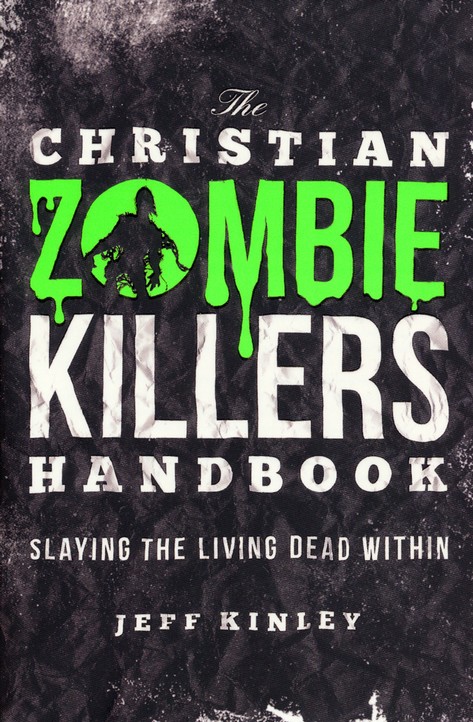
The Christian Zombie Killers Handbook by Jeff Kinley: Review

I know what you're thinking.  Christians...and zombie killers?  How much more oxymoronic can you get?   But I like mindbenders, and the title of this book alone was enough to intrigue me.  Still, I wasn't expecting much more than a thrill and maybe a laugh. Wrong.

This is not another half-hearted attempt to mishmash some cliches from popular culture with lukewarm Christian theology, which I suspected it might be as I leafed through the first few pages. Written in the style of The Zombie Survival Guide by Max Brooks, The Christian Zombie Killers Handbook is a blend of fiction infused with essay-style segments in between chapters, which sometimes tempts the reader to skip ahead to find out what happens next when Kinley ends a section at a particularly agonizing moment.

And yes, the narrative side is somewhat lacking--the characters are a little flat and some of the descriptions of the zombie attacks become repetitive--but what redeems the book is Kinley's theological discourses and his ability to move between his apocalyptic drama and the premises he seeks to defend.

The opening pages depict the main character, Ben Forman, discovering a zombie's victim--bloody and brainless.  Shortly afterward, we are given a lengthy but chilling history of zombies and the deadly Z-38 virus that causes it with a Biblical timeline in the background, melding into a depiction of the fallout after sin's curse and the entrance of evil into our planet.  The attacks in the small town Ben lives in come closer and become more personal as the story grows ever nearer to zombie apocalypse.  Throughout, Kinley weaves in the treacherous reality we all face--maybe not recognizable zombies, but a form of zombies nonetheless.  And occasionally, he injects a bit of humor into the grimness.

Overall, this book was well-worth reading.  The author's insights were valuable and thought-provoking, and lend a fresh perspective on society's zombie craze.  

Favorite Quotes:

"When your identity is found through being accepted by others, you will never be able to understand who you really are. You won't be able to discover the person God meant for you to become because you are constantly morphing into someone else, blending into the environment in order to be accepted. [....] God doesn't want you to conform to some cookie-cutter Christian image.  There's only one character image you should ever seek."  (p. 113-114)

"Perhaps the freedom we're all looking for isn't freedom to do what we want, but rather freedom from the con artist inside." (p. 81)

"And though we commit individual 'sins,' sin itself is the evil principle that inherently dwells within us.  It's more than some invisible disease we've acquired or a spiritual condition.  It's actually a part of who we are.  Inseparably intertwined in our spiritual DNA.  It's as much a part of us as our gender or skin color, illegitimately encoded in us the moment our first parents bit into that fruit." (p. 31)

"Until you look in that dungeon soul mirror and see the grotesque image staring back, you will never really understand what Jesus did for you.  You might want to go back and reread that last sentence again.  To rappel down to that pit of your heart is the best field trip you could ever take."  (p. 97)

"This is your Jesus.  Your conquering Hero.  Your zombie-killer." (p. 242)

Disclosure of Material Connection: I received this book free from the publisher through the BookSneeze®.com book review bloggers program. I was not required to write a positive review. The opinions I have expressed are my own. I am disclosing this in accordance with the Federal Trade Commission’s 16 CFR, Part 255: (http://www.access.gpo.gov/nara/cfr/waisidx_03/16cfr255_03.html) “Guides Concerning the Use of Endorsements and Testimonials in Advertising.”

Sunday, May 27, 2012

UCCS Theaterworks Student Production of Doctor Faustus: Review

This review was written on October 20, 2011.

Last Saturday evening, I went to see Doctor Faustus, performed at University Hall in the smaller theatre downstairs. As I took my seat on the front row right next to the side entrances to the stage, I noticed how the entirely black surroundings and the close seating seemed to envelope us, and all of our eyes were drawn to the white outline of the five pointed star centered on the stage floor.

As the lights dimmed to an anemic green and the fog started seeping over the audience, the dark, hazy outline of a human shape crawled toward us from the other side of the room. Sensing something through the vapors, I glanced behind me and flinched. Another one of these creatures crouched just below my foot. Five or six of them clustered in the midst of us, now screeching and wailing as the green light faded to darkness and the fog grew so thick that I could no longer see anyone else around me. Each one of us had been isolated in our own personal hell.

While the opening of Doctor Faustus brought me into the moment of the play, other aspects of the production, specifically the use of some of the props—and who moved them between scenes—as well as which actors played multiple parts, continued to intrigue me. First of all, the way props were used was interesting and effective. Hands detached from their owners who lurked behind the curtains manipulated a white cloth center stage just before the lights dimmed continued to use it to illuminate the words of Faustus’s contract with Lucifer as Faustus read it to us and then again later for a shadow puppet show as the townspeople in the tavern gossiped about the great magician Faustus. The five-pointed star continued to be used throughout the play, not just for scenes in which Faustus summons demons or performs magic, but also as the center for other action not directly related to incantations. Having the demons move the furniture and other props between scenes instead of crew was also very effective in keeping the theme of something evil lurking in the background throughout the play.

Secondly, the director’s choice of which actors played multiple characters added interesting connections between these characters that might not have otherwise existed in the text of the play itself. For instance, the actor who played Gluttony in the scene introducing us to Wrath, Envy, Pride, and Sloth also portrayed the pope at a religious feast in a subsequent scene. Also, the young woman who was the good angel in a luminescent white cloak became Lucifer almost directly afterward, dressed in the exact same costume. That particular change of roles was almost mind-warping, but it made sense as I remembered that Lucifer is described in Isaiah 14:12 as being the “son of the morning,” and one passage in Ezekiel that is interpreted to be about Lucifer says, “You were the seal of perfection, full of wisdom and perfect in beauty. You were in Eden, the garden of God; every precious stone was your covering” (Ezekiel 28:12-13). The production included several other instances of actors that depicted several characters which were probably not intended to be related to each other, although when Marlowe’s script was originally performed, similar associations like this may have happened if actors played multiple parts. Overall, I enjoyed seeing and analyzing the blend of acting and special effects in the UCCS VAPA student production of Doctor Faustus.

Doctor Faustus poster image copyrighted © University of Colorado at Colorado Springs VAPA department and Theaterworks.

Sunday, April 22, 2012

Harry Potter and Me, Part 2

If you haven't seen it yet, this blog post will make more sense if you've read Harry Potter and Me, Part 1 first.

Continuing onmore issues anti-Potter articles often mention.

Subjects That Hogwarts Students Study

Besides magic and spells, there are a few other subjects that, on first glance, might appear to correspond to occultic practices in our world. I will discuss how J. K. Rowling treats these subjects in her books.

1.) Divination

Yes, there is a class at Hogwarts, the wizard school Harry and his friends attend, called Divination. Professor Sybill Trelawney, a middle-aged witch who claims to have an "Inner Eye" and be able to prophesy. She tells the children to look for signs in crystal balls, the tealeaf residue left in teacups, and their dreams. Harry, Hermione, and Ron find this subject dull and completely useless, as Trelawney clearly fabricates the majority of her so-called predictions.  The headmaster, Professor Dumbledore, tells Harry that Professor Trelawney predicts the death of a student at the beginning of each school year.  The entire thing is obviously bogus, full of superstition and old wives' tales. Rather than being encouraged to seek out fortune tellers in our world, children would instead be taught to question their credibility. The only creatures capable of discerning the future in Harry's world are centaurs, who primarily use the movements of the stars to predict general trends or major events that will happenbut no specific details. In Harry's fifth year at school, a centaur named Firenze comes to teach them instead of Professor Trelawney, and he tells them that sometimes even centaurs can misinterpret astronomical phenomena. Furthermore, we must also consider that centaurs predict the end of the world by observing the stars and planets in The Last Battle, the seventh book of The Chronicles of Narnia.

The two exceptions about Trelawney's fortune-telling in the series (twice Professor Trelawney does actually prophesy accurately) do not originate from Sybill herself. She is unaware of having prophesied afterwards, so we must conclude that the prophesy comes from some cosmic force or something unexplained beyond the storybut again, we cannot presume that the prophesies come from an evil source if we have no textual evidence.

2.) Astrology

Some claimed that children reading Harry Potter would be encouraged to believe in astrology and horoscopes. But actually, Harry and his friends take a class called Astronomy, NOT Astrology, and it is just like the astronomy classes in the real world, from what details are mentioned in the books. And this is a class that doesn't come up much anyway.

School Holidays

Some people were uncomfortable about the idea that the students at Hogwarts celebrate Halloween. This is an issue that many Christians are divided onto dress up, or not to dress up. My personal opinion is that dressing up in a costume that isn't scary or evil, as well as participating in Harvest Festivals / Noah's Ark Parties at your church, are both perfectly okay. Harry and his friends participate in Halloween in an innocent way, like young children in our world do. And in the first book, Harry Potter and the Sorcerer's Stone, Harry's parents were murdered by Voldemort, the Dark Lord, when he was only one year old, on Halloween. Usually, in the first few novels, something important happens on Halloween to increase conflict and suspense, which is quite logical as it is the anniversary of Harry's parents' death as well as the beginning of the fall of the Dark Lord (more on that later).

Spells

The idea of Harry and his friends learning and saying spells bothered Christian parents, and for good reason. However, the spells in no way invoke spirits of any sort, and are all combinations of Latin phrases and made-up words. One spell, used by wizards who practice the Dark Arts, seems to be from Aramaic. As mentioned previously, how does that differ from children repeating "Bibbity-Bobbity-Boo" from Disney's Cinderella or even "Abracadabra"?   Or "Open Sesame"?   Or even when we say, "What's the magic word?" to remind children to say please?

Ghosts

Articles written against Harry Potter that I've read have also noted that there are ghosts in the books. This is true, but none of the characters ever conjure them up or summon them, but they do talk to the ghosts like they would to another person. One pro-Harry Potter article that I read argued that this was no different from Dickens' use of Marley or the ghost of Christmas Past in A Christmas Carol. The author said something to this effect: so should we not read A Christmas Carol because the main character consorts with ghosts and spirits?  In reading Charles Dickens' story, we recognize the distinction between fiction and reality. Why should Harry Potter or other fantasy stories be any different?

The Dark Arts

This area is where Christians should be concerned if evil magic in the story was glorified in any way. Yet it is clearly not. The kids take a class every year called "Defense Against the Dark Arts" and learn how to equip themselves against the villians. In Harry Potter and the Goblet of Fire, the fourth book, their Defense Against the Dark Arts professor, Professor Moody, teaches them about the three Unforgivable Curses--spells that are against wizarding law to use. They are the Imperius Curse (used for mind control, the word is Imperio), the Cruciatus Curse (used for torture, the word for it is Crucio), and the Killing Curse (the word for it is Avada Kedavra, apparently derived from Aramaic in what I uncovered in my research). Anyone who uses these curses on another human is sentenced to life in Azkaban, the wizard prison.

The good characters never use these curses, with one exception. Once Harry, in an understandable burst of anger, attempts to use the Crucio curse in a battle against a woman who just killed someone very dear to him, but she only stumbles, and tells Harry that he has to really mean it when he uses an Unforgivable Curse (the implication being that he is too innocent to actually want to torture another human being). In the last book, Harry continues to use the Expelliarmus spell to disarm his opponents, even though Professor Lupin tells him he must be prepared to kill if he needs to in order to defend himself. But he never, ever uses the Killing Curse against anyone. Voldemort uses Avada Kedavra continuallybut Harry practices only self-defense, which is intriguing considering the context of this series.

Expecto Patronum is one of the defensive spells Harry learns. He has to say the words while concentrating an intensely happy moment for the spell to work. It is used to repel dementorsevil, black-robed, soulless creatures that drain the happiness from a person and cause despair. Dementors also guard Azkaban prison. Riddikulus is another spell, used to combat boggarts, a creature that assumes the form of your deepest, darkest fear and lives in dark places like wardrobes and cupboards. It's best to face the boggart with someone else, to confuse it so it won't know what form to assume, and then the spell makes it assume something silly that makes you laugh, so the fear loses its power over you. Finally, Legilimency is used to read minds to an extent, or, more accurately, memories, and is practiced by Lord Voldemort and his followers, the Death Eaters. Harry attemps to learn Occlumency so that he can close his mind to Legilimency and protect it against evil influences. To guard his mind, he has to control his emotions.

Voldemort's return to a corporeal body, one of the more intense passages in the series, takes place at the conclusion of the fourth book. It is creepy, and rightfully so, because it could mirror actual occultic rituals, but again, these are the bad guys, not the admirable characters. The Dark Lord's servant makes a potion from the "bone of the [Voldemort's] father," the "flesh of the servant," and "the blood of the enemy" (he draws some of Harry Potter's blood) to come back to his full power.

Magic in our World

Other opponents of the series have been bothered by the fact that magic in Harry Potter is not just used in the wizarding world and at his school, Hogwarts, but that it also occurs in our world as well. (There is a connection between the wizard fantasy world and our worldHarry travels between the two through a brick wall at Platform 9 and 3/4 in a London train station). The magic is not just a long, long time ago in a land far, far away.  Yet since Harry and all the other young wizards are not allowed to use their magical abilities outside of school until they are adults unless there are life-threatening circumstances (and in the rare instances that this does occur), it is again only magic of the fairy tale variety that has already been discussed.


Now, having covered most of the fantasy elements that most arguments against the Harry Potter series utilize as evidence, I can now discuss why I find the books worth reading. As a Christian, I would never make the argument that a set of novel encouraging particiption in the occult, which also happened to be adventure stories with moral lessons, would be wholesome reading for anyone, let alone children. My friend Kathleen told me that some of her fellow online students in a college literature class argued, in a discussion where Harry Potter came up: "But the books teach children morality." In the words of one of my fellow English literature majors and good friend Cynthia, "that would be like mixing candy and poison." Yet because I have made the case that the magical elements in this series are not of the occult, now I will proceed to discuss what value I think the books have.

As I started reading the opening lines of the first book, I sensed something was afoot. It is the evening upon which the entire wizard world is rejoicing and exultant that a baby boy has caused the temporary defeat of the Dark Lord, Voldemort. They all look to him now as the cause of their joy and peace, the one who brought them deliverance.  ...Like the shepherds and angels in Bethlehem?   Honestly.  What else does this sound like? I realized that Harry had a clear potential for developing into a Messiah figure. But I knew I'd have to keep reading to find out if J.K. Rowling kept this up.

Throughout the series, each book entails a struggle against evil, and every school year, Harry meets the challenge. Harry matures as the Dark Lord grows stronger yet again.

Finally, the seventh and final book culminates with Harry sacrificing himself to save the world, realizing that only his death will bring about the ultimate and final defeat of Voldemort.  Sound familiar?  As he willingly walked through the forest to face the Death Eaters and his followers, reminding me of Aslan heading through the woods toward the White Witch and her crew at the Stone Table, we as readers hear his final thoughts, and the spirits of his mother and father and other dear friends who died in the struggles walk with him. At this point, I was completely crying my eyes out. The series had met my expectations at the beginning and exceeded them. And yes, his willing sacrifice enables him to come back and ultimately defeat the Dark Lord (who is, interestingly enough, completely loaded with symbolism involving snakes).

For further insight into the ending of the series:

J. K. Rowling in an interview with a Spanish newspaper in February 2008: "Since he was young until Chapter 34 of the seventh book, Harry is required to be a better man in that he is obligated to accept the inevitability of his own death. The plan of the books was that he should have contact with death and with the experience of death. And it was always Harry alone who had to have that experience. It all came down to conscience, because the hero had to live these things, do things, see things on his count. It’s part of that isolation and sadness that comes with being a hero.  For me, that chapter is the key of all the books. Everything, everything I have written, was thought of for that precise moment when Harry goes into the forest. That is the chapter that I had planned for 17 years. That moment is the heart of all of the books. And for me it is the last truth of the story. Even though Harry survives, of that there was no doubt, he reaches that unique and very rare state which is to accept his own death. How many people have the possibility of accepting their death before they die?"

"And he [Harry] set off. The dementors’ chill did not overcome him; he passed through it with his companions, and they acted like Patronuses to him, and together they marched through the old trees that grew closely together, their branches tangled, their roots gnarled and twisted underfoot. Harry clutched the [Invisibility] Cloak tightly around him in the darkness, traveling deeper and deeper into the forest, with no idea where exactly Voldemort was, but sure that he would find him. Beside him, making scarcely a sound, walked James, Sirius, Lupin, and Lily, and their presence was his courage, and the reason he was able to keep putting one foot in front of the other."  Chapter 34, Harry Potter and the Deathly Hallows

Dialogue from Harry's final battle with the Dark Lord:
"You won't be killing anyone else tonight," said Harry as they circled, and stared into each other's eyes, green into red. "You won't be able to kill any of them ever again. Don't you get it? I was ready to die to stop you from hurting these people"

"But you did not!"

"I meant to, and that's what did it. I've done what my mother did. They're protected from you. Haven't you noticed how none of the spells you put on them are binding? You can't torture them. You can't touch them. You don't learn from your mistakes, Riddle, do you?"

Concluding thoughts:

1.) There is some brief language and violence in the Harry Potter series, so children probably shouldn't read them when they are very young. Parents should decide what content their children are capable of handling.

2.) Don't make the mistake of not reading an author's work purely because of their lifestyle / biography. Some argued that children should not read Harry Potter because J.K. Rowling is not a Christian. On that note, we can't actually make that judgement call on whether she is or not—though I would argue her books potentially reveal much about her belief systemand there are many classic children's books and other works written by authors with lifestyles and worldviews we would likely not agree with, but we still enjoy reading them.  (Examples: The Secret Garden, A Little Princess, The Cricket in Times Square, the Frog and Toad series, and The Importance of Being Earnest.)

From the author herself:
"To me, [the religious parallels have] always been obvious,” Rowling said. “But I never wanted to talk too openly about it because I thought it might show people who just wanted the story where we were going.”

When asked if her books promote the occult, she said: "I think that’s utter garbage. I absolutely do not believe in the occult, practice the occult. I’ve never... I’ve met literally thousands of children now. Not one of them has said to me, 'You’ve really turned me on to the occult,' not one of them." (in an interview with Katie Couric on Dateline NBC, June 20, 2003)

"I did not set out to convert anyone to Christianity. I wasn't trying to do what C.S. Lewis did. It is perfectly possible to live a very moral life without a belief in God, and I think it's perfectly possible to live a life peppered with ill-doing and believe in God."

Upon being asked if she was a Christian, she replied, "Yes, I am, which seems to offend the religious right far worse than if I said I thought there was no God. Every time I’'ve been asked if I believe in God, I’'ve said yes, because I do, but no one ever really has gone any more deeply into it than that, and I have to say that does suit me, because if I talk too freely about that [her Christianity], I think the intelligent reader, whether 10 or 60, will be able to guess what’'s coming in the books.”

"The truth is that, like Graham Greene, my faith is sometimes that my faith will return. It's something I struggle with a lot. On any given moment if you asked me [if] I believe in life after death, I think if you polled me regularly through the week, I think I would come down on the side of yesthat I do believe in life after death. [But] it's something that I wrestle with a lot. It preoccupies me a lot, and I think that's very obvious within the books."

3.)  Ultimately, do not begin the series with your mind already made up about it. Honestly evaluate it for what it is.

Thank you for reading and and thinking along with me. Comments and counterarguments are welcome!

Bibliography:

Christianity Today: Redeeming Harry Potter
Christianity Today: Harry Potter Is Here to Stay


Saturday, April 21, 2012

Harry Potter and Me, Part 1

Most of you will probably either find this post either unnecessary if you came to this conclusion long ago or may be rather opposed to what I am about to say.  Recognizing both positions, I consider my effort to be worthwhile if a single person stumbles across it in browsing the web and decides to start thinking for themselves from reading this essay.  Last summer, after reading many arguments and articles online and in print for and against Harry Potter, discussing it with some of my writing friends and mentors in the CleanPlace Teen Writers' Group, and even having one of my professors, Dr. Martin, tell me last spring (with a quirky, half-smile) that I should read it for myself (not to mention Matthew, a classmate in my Intro to Literature class during my first semester of college, express similar thoughts), I decided that I would have to read the Harry Potter series to truly form an opinion about them.  While Christians probably shouldn't totally immerse ourselves in popular culture to the extent that we can't separate ourselves from it, I think that we need to at least be aware of what is happening in it and have an educated opinion about books and movies that make big waves in our society.  Harry Potter, I believe, is one of those elements of popular culture today that shows no sign of fading away anytime soon.  Delving into the texts themselves reinforced to me the importance of evaluating formulating my own opinions.

Shortly after I started the series, one of my friends from back in the Dallas Metroplex, Anna, sent me this article, "Twelve Reasons Not to See Harry Potter Movies."  (http://www.crossroad.to/articles2/HP-Movie.htm).  While the article expresses many parents' concerns, I have numerous issues with its logic.  Most of the reasons and claims provided in it are null and void once you disprove one of the earlier ones. Another aspect to keep in mind is that the article was written in 2001, when the series was only halfway complete and not all of the movies had been produced. Since this is a typical example of the fear-based articles that get circulated on the internet among conservative groups about Harry Potter and other children's media, I answered the author's claims blow-by-blow for my friend and am posting them in a more polished form. 

Sidenote: I have encountered four general types of Christian readers in my life to datepeople who believe reading all fiction is wrong (A older Mennonite lady who was a librarian in Montrose, Colorado told me once that her husband only read nonfiction, though she enjoyed fiction herself), people who believe any story with fantastical elements in it is wrong (this usually includes fairy tales, Greek mythology, as well as fantasy / science fiction), people who believe fantasy and magic is all right if a deity that corresponds allegorically to the God of the Bible is present (this would include Narnia and Donita K. Paul's DragonKeeper series, but not Lord of the Rings), and people who think that any fantastical elements in fiction are all right, deity or not, as long as any "magic" does not involve contacting spirits or acting as a medium.  Not everyone falls into these categories absolutely, but overall, it has been my experience that they generally do. 

And these two blog posts are not really intended for people in the first two groups.  I would have to have a different argument to first argue that reading fiction is not wrong in and of itself and that reading stories with fantasy / fairy tales are all right as well.  These essays are meant to show those in the third category what the viewpoint of the fourth category is like so they can honestly consider it...and perhaps discover they already liked several stories that fall in the fourth group. 

Spoiler Alert: For those who have not yet read the books, several major plot points must be revealed for the purposes of my argument.  Be forewarned. 

The article's first point is this:
"1. God shows us that witchcraft, sorcery, spells, divination and magic are evil."
Okay, I agree. The Bible verse they used, Deuteronomy 18:9-12, is correct.

Yet then the authors proceed to state:
"2. The movie's foundation in fantasy, not reality, doesn't diminish its power to change beliefs and values."
Err...ok. This is partly true. Yes, fantasy can teach us values and influence our thinkingbut that doesn't mean that people who read it will believe that every element in it is real. How many people actually try to get into Narnia through a wardrobe? Or believe an apple offered to them by an old woman will harm them like Snow White? Most readers, even children, recognize the difference between reality and fantasy or fairy tales, absorbing the meaning behind the story rather than the actual elements in the story. Kids do pretend these things are real sometimes, but they are usually just doing it in an innocent way.

"3. Each occult image and suggestion prompts the audience to feel more at home in this setting."
Hmm. Possibly. Butif the elements in Harry Potter are truly occultic, doesn't that mean we shouldn't read Lord of the Rings?   That series has a wizard, Gandalf, who uses magical abilities. And he's a good character. Someone we respect as readers.   And maybe we shouldn't read or watch The Wizard of Oz.   That story has a couple of "good witches" in it. The fairy godmother in Disney's Cinderella uses magic to rescue her, using a spell, "Bibbity-Boppity-Boo," and wand while wearing robes. (http://www.youtube.com/watch?v=IvcTI3ctK8o)  And what about Mary Poppins?  I don't say this in a cynical way; I mean it seriously.  Logically, we would have to ban all stories with fantasical elements from children's literature, not pick and choose the ones we like.  And I know people who dislike those books / stories for those exact reasons. But to me it doesn't make sense to say that those are okay and Harry Potter is not, when you honestly compare them. I never found a place in the series in which Harry or anyone else contacts the netherworld or demonic sourcesmagic in his world is like physics in our world and just happens to be there.  Wizards are born with magical abilities—it is not something they choose to attain like people who practice witchcraft in our world. You either have the gift at birth, or you don't. It's not stated as coming from a deity or any other source, but is just a part of the fantasy world. I think we cannot conclude that the magic in Harry Potter is what the Bible describes as witchcraft if we do not have any textual evidence in the books that the magic originates from an evil source.

"4. God tells us to 'abhor what is evil' and 'cling to what is good.'"
True.

"5. Immersed in Hogwarts' beliefs and values, children learn to ignore or reinterpret God's truth."
I'm not sure where the authors are getting this.  Sometimes the kids in Harry Potter are mischievous. They disobey the rules sometimes and sneak around after curfew, but they usually have good intentions of trying to stop something bad from happening.  (Not that this justifies their behavior, but we have all made similar mistakes).  Once, in the third book, Harry Potter and the Prisoner of Azkaban, Harry sneaks out through a secret passage to a village near the school, Hogwarts. All the other people in his grade level and higher were allowed to go that afternoon, but he didn't because he didn't have a signed permission slip from a legal guardian.  Harry wants to go to the candy shop and toy shop.  In this instance, he doesn't even have a good reason for disobeying. But when he gets back, he very nearly gets caught by his least favorite professor, and another one of his teachers, Professor Lupin, keeps him out of trouble, yet reminds Harry that Harry's parents died to save him as a baby, and he thinks it's a poor way for Harry to live in light of their sacrifice: "Your parents gave their lives to keep you alive, Harry. A poor way to repay themgambling their sacrifice for a bag of magic tricks."  Harry and his friends are human, and make poor decisions at times like all of us, but he's usually reprimanded for it somehow.  Consequences do exist in Harry's world, despite it being a magical one. 

"6. This inner change is usually unconscious, for the occult lessons and impressions tend to bypass rational scrutiny. After all, who will stop, think and weigh the evidence when caught up in such a fast-moving visual adventure? Fun fantasies and strategic entertainment has a special way of altering values, compromising beliefs and changing behavior in adults as well as in children."
As consumers of media in so many forms, we do get caught up in any movie / book / other entertainment easily without considering the message behind the entertainment.   But this applies to many things, not just Harry Potter in particular. Once we develop critical thinking skills and learn to analyze books and movies while we are being entertained by them or after we finish them, much of this danger is mitigated. Most children don't do this, though, which is why their parents should discuss these things with them.

"7. The main product marketed through this movie is a new belief system. This pagan ideology comes complete with trading cards, computer and other wizardly games, clothes and decorations stamped with HP symbols, action figures and cuddly dolls and audio cassettes that could keep the child's minds focused on the occult all day and into night. But in God's eyes, such paraphernalia become little more than lures and doorways to deeper involvement with the occult."
I believe I mostly addressed this under points #3 and #5, having stated that all of the magical elements in Harry Potter are not any different from other fairy tales and fantasy stories.  Many other series/movies come with trading cards and computer games and other merchandise, too.  Honestly, people can become obsessed with anything to an unhealthy extent.

"8. The implied source of power behind Harry's magical feats tend to distort a child's understanding of God. In the movie as in the books, words traditionally used to refer to occult practices become so familiar that children begin to apply the same terms to God and His promised strength. Many learn to see God as a power source that can be manipulated with the right kind of prayers and ritualsand view his miracles as just another form of magic. They base their understanding of God on their own feelings and wants, not on His revelation of Himself." 
I can understand how perhaps this could be a concern in how children view God—except there is no deity in Harry Potter's worlda point many anti-Potter arguments I have read that were not as concerned with the fantasy elements have emphasized.   But don't even people who never read fantasy view God in this way?   We cannot blame this inaccurate view of God on Harry Potter or even other fantasy stories in general.   Even some Christians maintain a perception of God as simply the one you go to when you want something.

"9. Blind to the true nature of God, children will blend (synthesize) Biblical truth with pagan beliefs and magical practices. In the end, you distort and destroy any remnant of true Christian faith. For our God cannot be molded to match pagan gods."
As long as children (and adults) recognize the difference between fiction and reality, they will not fall into that trap.   Enough said.

"10. God tells us to 'train up a child in the way He should go.' It starts with teaching them God's truths and training them all day long to see reality from His, not the world's perspective. To succeed, we need to shield them from contrary values until they know His Word and have memorized enough Scriptures to be able to recognize and resist deception. Once they have learned to love what God loves and see from His perspective, they will demonstrate their wisdom by choosing to say 'no' to Harry Potter."
Mostly true...but the children's saying "no" to Harry Potter hinges on the books' being classified as occult, which I do not think is accurate.

"11. While some argue that Harry and his friends model friendship and integrity, they actually model how to lie and steal and get away with it. Their examples only add to the cultural relativism embraced by most children today who are honest when it doesn't cost anything, but who lie and cheat when it serves their purpose."
I think I addressed this with #5. As I came to this point, I began to suspect the person who wrote this article did not actually read the books, or read them and saw what they wanted to see in them, having formulated their conclusions beforehand. And I don't remember Harry or the others actually stealing. Sometimes they are sneaky or tell half-truths, and sometimes they do get away with it, but usually they are trying to do the right thing in the wrong way, and they are corrected in wrongdoing (as mentioned earlier about Professor Lupin's conversation with Harry). The kids learn from their mistakesHarry makes a mistake in book five, Harry Potter and the Order of the Phoenix, that actually costs Harry's godfather his life, because Harry falls prey to a trap from the Dark Lord, thinking he is rescuing his godrather Sirius. Harry chooses not to consult adults in the matter, but rushes headlong into the situation, following what Hermione calls his "saving people thing."  Sirius comes with others to rescue Harry and his friends from the trap they fall into...and Sirius dies saving Harry. Harry never forgets this, and resolves in the last book that no one else will die for him: "Dumbledore knew, as Voldemort knew, that Harry would not let anyone else die for him now that he had discovered it was in his power to stop it" and "'I never wanted any of you to die for me.'"

"12. God has a better way. When His children choose to follow His ways, He gives them a heart to love Him, spiritual eyes that can understand and delight in His Word, a sense of His presence and a confidence in His constant careno matter what happens around us. Harry Potter's deceptive thrills are worse than worthless when compared to the wonderful riches our Shepherd promises those who will ignore evil and walk with Him."
That point is also true...but again, is dependent on the previous claims that classify Harry Potter as occultic. The authors keep trapping us into agreeing with them by mixing truth with fabrication and exaggerations.  Furthermore, can we be so certain that Harry Potter is diametrically opposed to the Christian worldview?

In my next post, I want to discuss more arguments commonly used to discourage reading the books and my own experience with the Harry Potter series and what I actually do see in themthemes and other elements.  Analyzing one of the anti-Potter articles circulating on the web line-by-line pushes us to think critically without becoming emotionally invested in one side or the other. 

Next post: Harry Potter and Me, Part 2